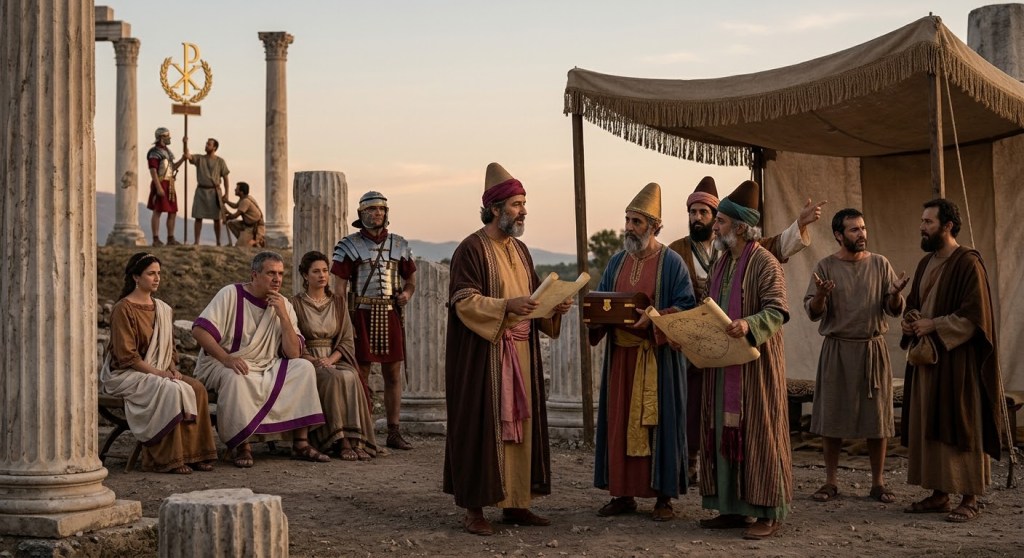
The Magi represent both political machinations and pagan wisdom. Several ancient sources record notices of a Magus (the singular of “Magi”) who challenged the Persian king Cambyses in the fifth century BCE. The Roman historian Suetonius notes that Tiberius, the emperor at the time of Jesus and who was concerned about political challenge, banished all astrologers from Rome in 19 CE. Josephus, our first-century Jewish historian, mentions a Magus who arranged the marriage of the Roman governor Felix to Drusilla, the sister of Agrippa II (see Acts 24:24-25). The affair was scandalous. Acts also mentions not only Simon Magus, who tricks the Samaritans and then seeks to buy the power to bestow the Holy Spirit (see the marvelously camp movie The Silver Chalice, with Paul Newman in his film debut and Jack Palance playing Simon Magus), but also Elymas Bar Jesus, in the employ of the Proconsul of Cyprus, who opposes Paul. Thus, when Magi appear in ancient sources, kings should get nervous. On the other hand, Persian legend speaks of Magi present at the birth of King Cyrus.
In fact, the Magi of Matthew 2 only start to get a royal designation after the Emperor Constantine, seeing the Greek letters chi and rho in the heavens, converts to Christianity. The sign of the letters becomes associated with the star of Bethlehem. The result of this connection was of political benefit: just as the Magi, seen now as kings, paid homage to Jesus by following his star, so the kings of the earth should pay homage to the emperor by following his sign.
Amy-Jill Levine in A Beginner’s Guide to Advent (Abingdon Press).


Leave a Reply